

Flywheel Energy Storage: How Flywheel Systems Work - and Why They Matter Now

Qnetic Flywheel Energy Strorage
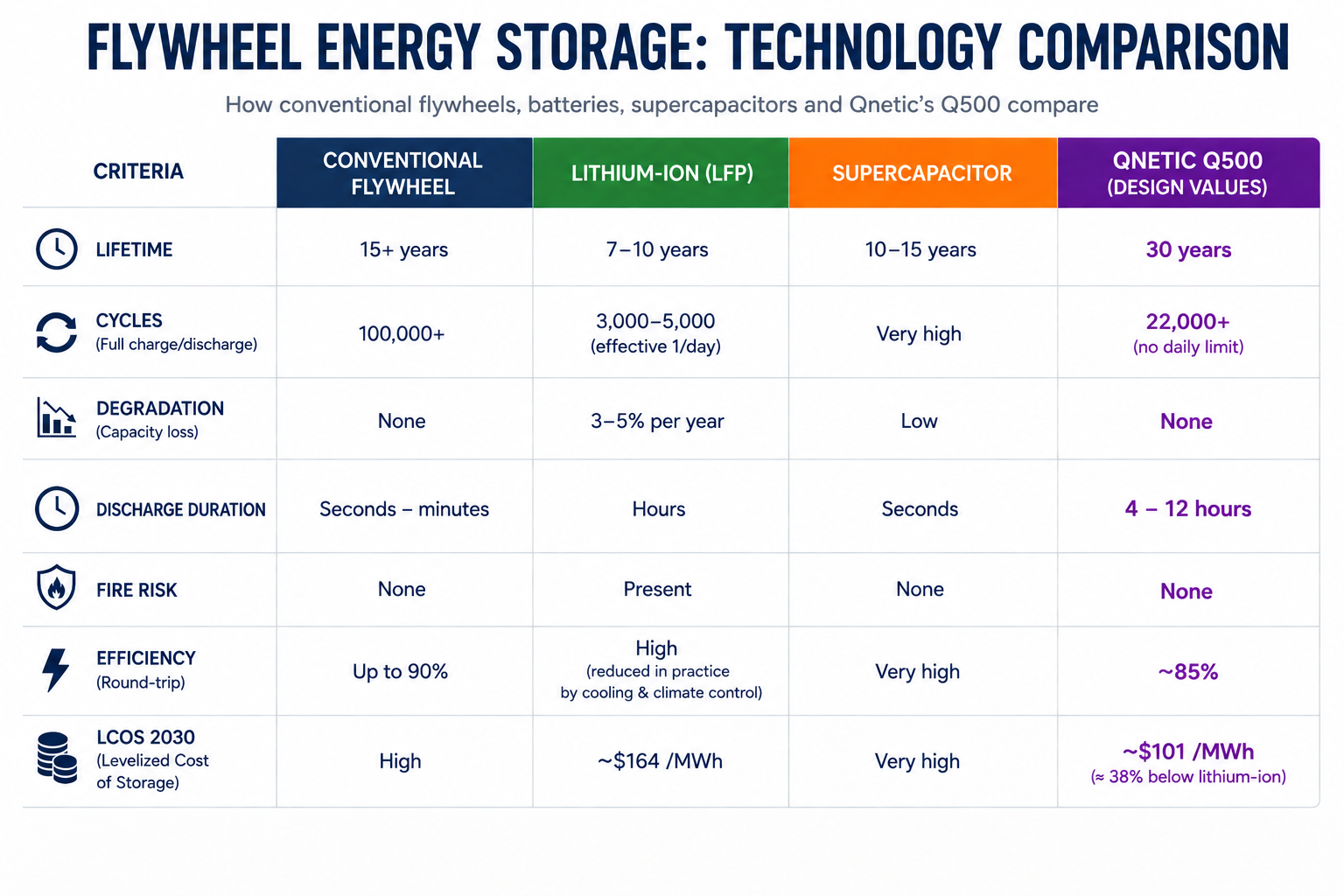
Flywheel Energy Storage - Technology Comparison
A closer look at how flywheel storage works, what Qnetic promises, and what still needs to be proven.
People say you have to beat lithium-ion on cost. But as cells become a smaller share of project costs, value matters more than price.”
NEW YORK, NY, UNITED STATES, October 13, 2026 /EINPresswire.com/ -- Inside a vacuum chamber, a carbon-fiber rotor spins at nearly three times the speed of sound. What sounds like laboratory physics is an attempt to challenge a market that has so far been dominated by a single technology: the lithium-ion battery. Flywheel energy storage systems were considered a niche solution for decades, primarily suited to applications lasting seconds. A U.S. startup with operations in California and Shanghai is now aiming to extend that range from seconds to as long as 12 hours. The physics support the concept. The economics will have to prove it.— Michael Pratt, CEO Qnetic
- A flywheel energy storage system stores electricity mechanically as rotational energy—with no chemicals, no lithium, and no degradation.
Conventional systems typically deliver power for seconds to minutes. Qnetic’s Q500 is designed for 125 kW and up to 500 kWh, enabling multi-hour discharge cycles
- The economic advantage is not the upfront purchase price but the number of cycles: the equivalent of two full-discharge cycles per day instead of one, without compromising performance or longevity coverage.
- A projection commissioned through Imperial Consultants puts the levelized cost of storagein 2030 at around $101 per MWh, compared with $164 per MWh for lithium-ion.
- Qntetic’s technology has yet to be proven at commercial scale: an alpha prototype currently exists and is in testing, orders are non-binding letters of intent, and independent EPRI validation testing has recently begun.
An Old Idea, Recalculated
Electricity does not necessarily have to be stored chemically. It can also be stored as motion. That is precisely what a flywheel energy storage system does. A motor accelerates a mass, storing energy in its rotation. When power is needed, the same machine slows the rotor down and converts the motion back into electricity.
The critical factor is not weight but rotational speed. Doubling the rotational speed quadruples the amount of energy stored. That is why modern systems use composite materials rather than massive steel rotors. Qnetic, the company behind the rotor described above, puts the energy density of its carbon-fiber rotor at roughly six times that of a steel rotor. CEO Michael Pratt illustrates the difference this way: “A steel rotor would have to weigh several hundred tons to achieve the capacity of the first Qnetic system—whereas optimized fiber alignment and a thin-walled hollow design require only five to six tons.”
The second difference from batteries is more fundamental. A lithium-ion cell stores energy through an electrochemical reaction that loses a small amount of capacity with every cycle as well as ages with time. A flywheel does not experience this type of chemical degradation. The energy is stored in the physics of rotational motion—and physics does not age.
How a Flywheel Energy Storage System Works
The process can be described in five steps and is essentially the same across different system designs:
- Electricity from the grid flows into the system’s motor-generator.
- The motor accelerates the rotor to thousands of RPMs
- The rotor spins inside a vacuum chamber with virtually no friction and stores the energy.
- When power is required, the motor operates as a generator and slows the rotor.
- The rotational energy is converted back into electricity for the grid.
Response times are measured in milliseconds. Qnetic specifies less than three milliseconds for its design. That speed makes flywheels particularly attractive wherever power must be available immediately. The trade-off is standby loss: magnetic drag from the motor-generator can result in self-discharge. Qnetic modeling estimates that its design holds 50% of the stored energy after more than two weeks of standby.
Four Components, One System
- Rotor – the rotating mass that stores the kinetic energy.
- Motor-generator – converts energy in both directions; Qnetic refers to it internally as the “Genmo.”
- Magnetic bearings – keep the rotor suspended without physical contact, eliminating the need for lubrication and conventional wear parts. Qnetic combines active and passive bearings so that the entire mass does not have to be actively levitated.
- Vacuum enclosure – minimizes air resistance and therefore reduces standby losses.
Qnetic sources its inverter technology from ABB, while assembling the core system in its own facilities. Three of four PCT patent applications covering the rotor and bearing system have been published and are therefore publicly accessible.
Why the Technology Has Remained a Niche
Flywheels are not an invention of the current decade. They have been used commercially for years, including at Beacon Power’s facility in New York State and Pennsylvania, each of which provides 20 megawatts of frequency regulation. However, conventional systems are typically designed for storage durations ranging from about 20 seconds to 20 minutes. That is sufficient for uninterruptible power supplies and grid stabilization, but not for shifting large amounts of electricity over several hours.
Pratt frames the problem in business terms: Existing systems are like “sports cars—high performance, limited utility.” What the grid needs, he argues, is a tractor-trailer: very high capacity, deep endurance (duration) and low cost. Qnetic therefore started from scratch and designed a system intended to operate one to two orders of magnitude above what is currently available.
The Breakthrough: From Seconds to Hours
The company’s initial product is called the Q500. It is designed for 125 kilowatts of power and up to 500 kilowatt-hours of usable energy—equivalent to four hours of discharge at full power and up to 12 hours at reduced power. A one-megawatt-hour version has also been announced.
The company has taken a “safety first” approach starting with the fatigue modeling of the rotor all the way through the containment design. The enclosure is designed to withstand a complete rotor failure at speeds of up to 12,000 revolutions per minute, and the system can be installed underground. This is more than a technical detail—it is a key safety feature in the siting and permitting process.
The Real Calculation Is Not a Cost Calculation
The economic case for the technology is not primarily based on its purchase price but on the total energy throughput it can support over its lifetime. Battery storage operators are effectively limited to around one charge-discharge cycle per day to minimize degradation and staying withinmanufacturers’ warranty limits which are typically limited than 300 full cycles per year. Operating a system more frequently can put warranty coverage at risk and therefore limits revenue potential—because a storage system only generates revenue when it is operating.
“Many people say that if you can’t beat lithium-ion on cost, it won’t work—but it’s not that simple. At some point, the cell becomes a smaller and smaller share of the project cost. It’s not just about cost; it’s about value.”
Michael Pratt, CEO Qnetic
Qnetic argues that its storage technology can operate at two to three cycles per day without significant degradation and without shortening the system’s lifespan. Over a 30-year operating period, the company says, a Q500 could therefore cycle more than three times the amount of energy of a battery. The economic value of a storage project consequently depends on the present value of future revenues—and that value increases with the number of charge-discharge cycles the system can perform.
On the cost side, Qnetic points to a study by Oliver Schmidt and Iain Staffell of Imperial College London, conducted through its consulting unit Imperial Consultants (ICON) and projecting costs for 2030. The study estimates the levelized cost of storage (LCOS) at roughly 38 percent below lithium-ion, at approximately $101 versus $164 per megawatt-hour. In its own updated calculation, which factors in multiple daily cycles, Qnetic now arrives at roughly half the cost of lithium-ion. An important qualification is that the study itself was independently conducted but commissioned by Qnetic; the more aggressive figure comes from the company itself.
Supply Chains as a Selling Point
Qnetic’s second argument focuses on geopolitical independence. A large share of the world’s battery cells are produced in China. Even energy storage systems manufactured outside China largely rely on Chinese components. Michael Pratt points to companies that have invested billions of dollars in gigafactories in Europe and the United States but have struggled to compete with China’s cell manufacturing industry. In his view, competing with China’s lead in cell production is exceptionally difficult.
A flywheel largely sidesteps this issue because it is made from widely available engineering materials: carbon fiber, steel, aluminum, copper and magnets. Carbon fiber is produced in Japan, the United States and Europe, while steel and aluminum are globally available. The major exception is neodymium magnets, where China has a significant dominant position. Pratt argues, however, that the quantities required are small relative to global consumption in motors and electronics.
Trade policy is also strengthening this argument. The Section 301 tariff on Chinese lithium-ion batteries outside the automotive sector—meaning cells used specifically for grid storage—increased from 7.5 percent to 25 percent on January 1, 2026. That raises the cost of the dominant storage technology in the world’s largest market.
Fire Safety and Permitting
One factor often overlooked in technical comparisons can have very tangible consequences at the project level. Lithium-ion battery fires are difficult to control, and affected facilities can burn completely. Pratt reports objections from fire departments during the planning stage and cites as examples communities in New York State that have declared moratoriums and even full bans on battery installations. A mechanical storage system without volatile chemicals can therefore have an easier path through community acceptance and permitting process.
The Market: Small by Measurement, Large by Narrative
The actual size of the flywheel energy storage market depends heavily on how it is defined. Straits Research estimates the market at $475.87 million in 2025 and expects it to reach approximately $1.08 billion by 2034, representing annual growth of 9.5 percent. Future Market Insights puts the 2025 market at around $1.4 billion and forecasts $2.0 billion by 2035, with a more moderate annual growth rate of 4.2 percent. Still other forecasts indicate more aggressive growth to as much as $4-$6billion annually by 2035. What all these estimates align on is solid growth prospects for this nascent segment.
By segment, Future Market Insights estimates that utilities and grid applications account for around 35 percent, data centers for 25 percent, with transportation and rail, industry and defense making up the remainder. North America leads by region, followed by Asia-Pacific and Europe. Established players include Beacon Power, Amber Kinetics, Stornetic, VYCON, Langley Holdings, OXTO Energy and Punch Flybrid. The important distinction among these players is that most focus on small sizes (e.g., residential) or small capacities (e.g., for UPS systems).
Michael Pratt presents a much larger market opportunity. He points to estimates that the U.S. market for energy storage is expected to grow to around $300 billion, with the global market approaching $3 trillion. The difference from the market research estimates is not necessarily a contradiction but a matter of definition: Pratt is referring to the entire energy storage market, while the research firms focus on currently deployed flywheel technology. For evaluating Qnetic’s business model, however, the distinction is significant.
The strongest current driver is the rising power demand from data centers. Pratt expects electricity demand to roughly double by 2028, with AI workloads creating fluctuations of hundreds of megawatts within milliseconds. Operators are responding with hybrid systems: the flywheel absorbs high-frequency peaks while the battery handles the baseline load, potentially extending the battery’s useful life.
What Is Proven—and What Is Not
Despite the argument's plausibility, the Q500 is not yet a commercial production product. What exists is a commercial scale alpha unit called Pulsar, a prototype design of 200 kWh capacity and 125 kW power. Ths unit will be used for initial low-speed testing to prove out the controls and safety systems. Its smaller predecessor prototype, Vega, reached 10,000 revolutions per minute and crucially, validated the bearing design and engineering models.
Efficiency is also not a unique selling point. With a round-trip efficiency targeting 85 percent, the Q500 sits right in the sweet spot of performance. While lithium-ion systems will claim up to 92% RTE, real world results experience shows they deliver significantly lower efficiency than their datasheet figures because of heating and cooling requirements to maintain the safety of the battery. The argument is plausible, but it has yet to be demonstrated in a comparable field environment.
The company’s current order pipeline is also based on letters of intent. Qnetic puts the volume at around $110 million, corresponding to approximately 460 megawatt-hours and more than 900 units. The agreements are explicitly non-binding. For a hardware company, its financing to date is relatively limited. Since its founding, Qnetic says it has raised $9.2 million, including $2.1 million through a crowdfunding campaign and most recently $5 million through a Regulation Crowdfunding round—the legal maximum under that U.S. financing regime. Investors named by the company include venture capital firm SOSV and an unnamed Saudi investor. For 2026, the company has set a new financing target.
Pratt makes no secret of the timeline. Pilot projects are scheduled to begin in 2027. Typically, he says, one to two years pass between commissioning and an order, with larger commercial projects following one to two years after the pilots. Profitability immediately after a pilot project should not be expected; like most hardware companies, they will need to achieve scale to drive down costs and achieve margins.
On the positive side, the company is subjecting its technology to external evaluation. In August 2026, Qnetic was accepted into the deRISKED program of the Electric Power Research Institute (EPRI), sponsored by California utility Sacramento Municipal Utility District. Beginning in 2027, the system is expected to enter EPRI’s standard testing protocol, with results distributed to the deRISKED program member utilities worldwide. In addition, validation has been agreed at the Ares test site operated by the National Laboratory of the Rockies, using load profiles representing wind, solar and AI data centers. This ties the technology to a specific grid environment rather than relying solely on standardized test protocol figures.
Manufacturing takes place in Sacramento, California. The technology center is located in Shanghai, with additional offices in Singapore and Germany.
Conclusion
Flywheel energy storage does not solve a problem that batteries already solve. Instead, it addresses some of the problems associated with batteries: degradation, cycle limitations, fire risk and supply-chain dependencies. For frequency regulation and grid stabilization, the technology has technical advantages over batteries—a position supported by years of field experience.
Qnetic’s approach is economically interesting because it shifts the comparison away from the upfront cost per kilowatt-hour and toward the value of the energy cycled over the system’s lifetime. That argument ultimately depends on two critical proofs: that the rotor can operate reliably for 30 years and that operators can monetize the potential for multiple daily cycles in actual power markets. Those questions are unlikely to be settled before the pilot projects and EPRI test reports beginning in 2027.
Qnetic at a glance
Founded by CEO Michael Pratt and CTO Loïc Bastard, Qnetic is developing the Q500, a solid-state flywheel energy storage system designed for long service life and grid-scale applications.
Michael Pratt
Qnetic Energy Storage Inc.
media@qnetic.energy
Visit us on social media:
LinkedIn
Instagram
YouTube
Legal Disclaimer:
EIN Presswire provides this news content "as is" without warranty of any kind. We do not accept any responsibility or liability for the accuracy, content, images, videos, licenses, completeness, legality, or reliability of the information contained in this article. If you have any complaints or copyright issues related to this article, kindly contact the author above.
