

Stem Cell Manufacturing Market to reach USD 55.92 Billion by 2035 at 11.8% CAGR
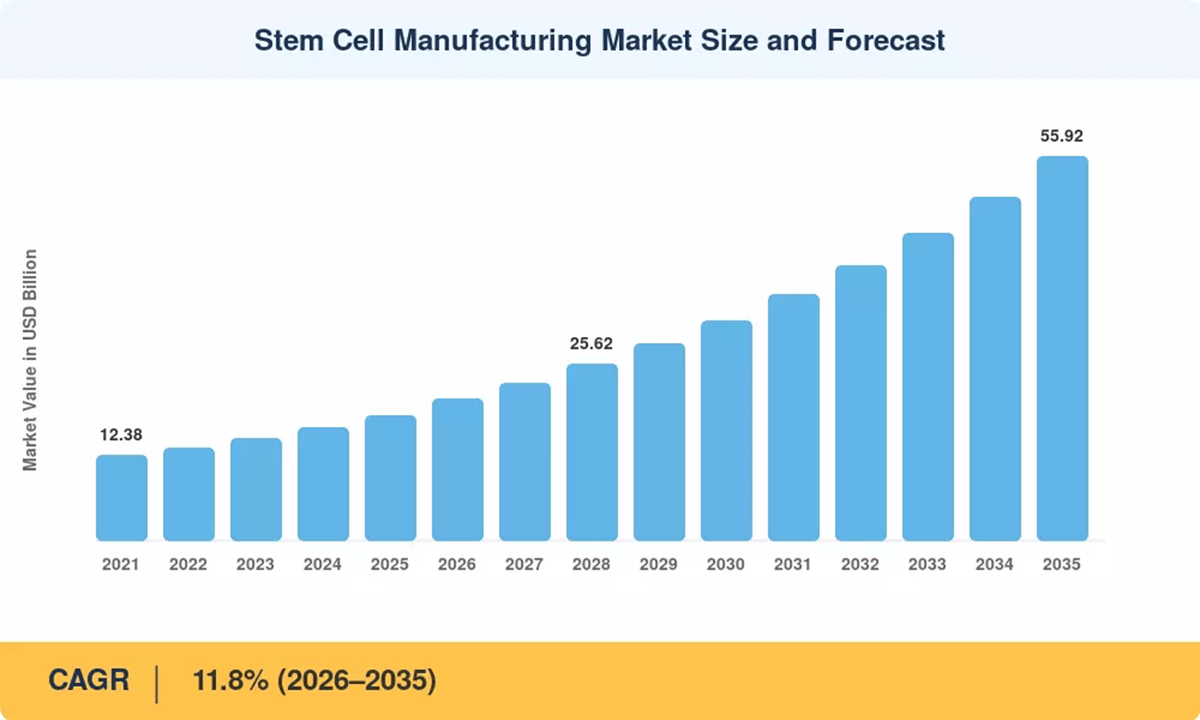
Stem Cell Manufacturing Market Size
Stem Cell Manufacturing Market to Surge from USD 20.54B in 2026 to USD 55.92B by 2035-By Expanding Cell and Gene Therapy Pipeline, Regulatory Harmonization
NY, CA, UNITED STATES, July 13, 2026 /EINPresswire.com/ -- As per Market Research Future, the global Stem Cell Manufacturing Market size to reach USD 55.92 Billion by 2035 from USD 20.54 Billion in 2026, at a CAGR of 11.8% during the forecast period 2026--2035. The market base was estimated at USD 18.22 Billion in 2025.The 11.8% CAGR---anchored by structural therapeutic manufacturing demand rather than discretionary spending---is driven by three converging forces: the FDA's Center for Biologics Evaluation and Research reporting more than 3,700 active investigational new drug applications for cell and gene therapy products as of mid-2024, more than tripling the number from 2019; the technology shift from legacy open-vessel, flask-based culture systems toward automated closed-system bioreactors equipped with in-line process analytical technology.
Reducing contamination episodes by as much as 40% and operator touch-points by 60%; and accelerating regulatory harmonization, with Japan's 2024 revision of the Act on the Safety of Regenerative Medicine establishing the first comprehensive quality framework for both autologous and allogeneic cell products, triggering reciprocal policy reviews in South Korea, Australia, and the EU. The Stem Cell Manufacturing Market is no longer an academic research supply category---it sits at the intersection of commercial therapeutic production, bioprocess automation, and global regulatory convergence.
Request A Free Sample: https://www.marketresearchfuture.com/sample_request/6942
Key Market Trends & Growth Drivers
Expanding Cell and Gene Therapy Pipeline
As of mid-2024, the FDA's Center for Biologics Evaluation and Research reported more than 3,700 active investigational new drug applications for cell and gene therapy products, more than tripling the number from 2019. Each late-stage candidate requires GMP-grade stem cell inputs at volumes that current manual production lines cannot provide.
Contract manufacturers are commissioning additional cleanroom suites on the back of this pipeline strain, with Catalent, Lonza, and Samsung Biologics announcing approximately USD 1.8 billion in cell therapy capacity investments between 2023 and 2025. Each percentage point of pipeline expansion translates into measurable procurement volume, and the multi-year clinical development paradigm embedded in cell therapy manufacturing makes this driver structurally durable through 2035.
Closed-System Bioreactor Adoption
Contamination is still the costliest failure mode in stem cell manufacturing, where a single lost batch can amount to USD 500,000--2 million worth of wasted material and labor. Automated, closed-system bioreactors from vendors like Cytiva, Sartorius, and Eppendorf can decrease contamination episodes by as much as 40% and reduce operator touch-points by 60%, according to a 2024 ISCT benchmarking study.
This trend toward these platforms is changing the capital spending patterns across the Stem Cell Manufacturing Market, especially for CDMOs servicing numerous therapeutic sponsors at the same time. Early-adopter facilities report that closed-system automation improves batch consistency and reduces unplanned downtime compared with open-vessel manual workflows.
Regulatory Harmonization
Japan's 2024 revision of the Act on the Safety of Regenerative Medicine established the first comprehensive quality framework for both autologous and allogeneic cell products, triggering reciprocal policy reviews in South Korea, Australia, and the EU. The EMA followed with updated guidelines on ATMP manufacturing in early 2024, while China's NMPA finalized its cell therapy clinical trial registration pathway in late 2024.
This convergence lowers cross-border market entry barriers for the Stem Cell Manufacturing Market and encourages multinational manufacturers to standardize processes across facilities. In areas where regulatory fragmentation and divergent classification standards slow translational pace, investment in harmonized quality systems is accelerating commercialization timelines.
Ask for Customization: https://www.marketresearchfuture.com/ask_for_customize/6942
Market Segment Insights
BY PRODUCT TYPE
Consumables: Dominant segment with ~43.2% revenue share in 2025. Reflecting their repeat-purchase nature in every production cycle. Every manufacturing run---whether for autologous patient-specific products or allogeneic master-cell-bank-derived batches---consumes reagents, culture vessels, separation kits, and cryopreservation bags. This repeat-purchase dynamic insulates the segment from cyclical investment fluctuations and provides predictable revenue streams for suppliers like Thermo Fisher, Merck KGaA, and STEMCELL Technologies.
Instruments: Fastest-growing product class at 12.6% CAGR (2026--2035). Fueled by cell therapy production facilities upgrading from manual flask-based culture to automated bioreactor platforms. The shift encompasses not only bioreactors themselves but also cell counters, flow cytometers, and automated fill-finish systems that reduce operator dependency and improve batch consistency. As automation consolidates around GMP-compliant platforms, manufacturers able to supply integrated closed-system bioreactors capture a disproportionate share.
Culture Media: 18.0% share in 2025; transition to xeno-free and chemically defined formulations drives premium pricing and lot-to-lot consistency improvements.
Stem Cell Lines: USD 2.19 Billion in 2025; iPSC master cell bank development and commercial-grade cell line licensing create high-value recurring revenue.
Services: 10.8% share in 2025; CDMO outsourcing for clinical-stage sponsors and process development consulting represent incremental demand channels.
BY APPLICATION
Stem Cell Therapy: Dominant application with ~47.4% of 2025 revenue, representing roughly USD 8.64 Billion. Supported by a growing clinical pipeline of CAR-T and MSC-based treatments. Over 2,000 clinical trials involving stem cell--based interventions were active globally in 2024, spanning oncology, autoimmune disease, cardiovascular repair, and neurological disorders. Commercial approvals such as Kymriah, Yescarta, and Breyanzi have validated the therapeutic category and created commercial-scale manufacturing demand.
Stem Cell Banking: Fastest-growing application segment at 13.4% CAGR. Private cord blood banking registrations grew at approximately 14% annually between 2021 and 2024, driven by rising parental awareness and expanding clinical indications for hematopoietic stem cell transplantation. Banking operators are expanding into cord tissue and placental stem cell storage, broadening the value proposition beyond traditional hematopoietic applications.
Drug Discovery & Toxicology: USD 5.10 Billion in 2025; pharmaceutical R&D demand for cell-based assays and iPSC-derived organoid models drives steady volume.
Research & Development: Growing segment at 10.2% CAGR; academic and government-funded early-stage discovery programs expand the addressable base beyond commercial therapeutics.
BY PRODUCTION METHOD
Cell Expansion: Dominant production method with ~52% of demand in 2025. The volumetric backbone of stem cell manufacturing, encompassing bioreactor-based expansion, flask passaging, and perfusion culture systems. Each commercial-scale therapy requires billions of cells, making expansion the most material-intensive and capacity-constrained step.
Cell Differentiation: Fastest-growing production method at 13.8% CAGR. iPSC-derived allogeneic therapies require directed differentiation into target cell types---cardiomyocytes, neurons, pancreatic beta cells---creating demand for specialized differentiation media, growth factor cocktails, and maturation protocols.
Cell Preservation: USD 2.87 Billion in 2025; cryopreservation, controlled-rate freezing, and cold-chain logistics underpin master cell bank and final product stability.
BY END USER
Pharmaceutical & Biotechnology Companies: Largest segment at ~55.3% share in 2025, representing roughly USD 10.08 Billion. Reflecting their dominance in commercial-scale production and late-stage clinical supply. Large pharma sponsors increasingly build internal cell therapy production capacity alongside outsourced CDMO partnerships to mitigate supply chain risk. National procurement through centralized supply chains and long-term supply agreements dominates volume.
Academic & Research Institutes: Fastest-growing end-user segment at 12.8% CAGR. Supported by expanded NIH, Horizon Europe, and national-level grant allocations that directly fund cell-culture reagent procurement and GMP facility construction. The shift toward government-funded regenerative medicine and stem-cell research creates a structural academic tail that supports premium-grade manufacturing demand.
Cell & Tissue Banks: USD 4.37 Billion in 2025; storage, processing, and distribution infrastructure for cord blood, bone marrow, and tissue-derived stem cells.
Contract Manufacturing Organizations: Growing segment at 11.5% CAGR; CDMO outsourcing for clinical-stage sponsors accelerates as pipeline complexity outpaces in-house capacity build-out.
Read Detailed Insights: https://www.marketresearchfuture.com/reports/stem-cell-manufacturing-market-6942
Regional Outlook
North America --- Dominant Market (~38.0% Share, 2025)
The United States generates approximately 78.5% of North American Stem Cell Manufacturing Market revenue, driven by a combination of sustained NIH funding exceeding USD 2 billion annually, a transparent FDA biologics licensing pathway, and the densest concentration of cell therapy CDMOs globally. The FDA's updated CMC guidance for cell therapy investigational new drug applications, published in September 2023, clarified expectations for in-process testing and lot release, reducing regulatory uncertainty for sponsors. Reimbursement breadth and biopharma R&D concentration support premium-priced GMP-grade manufacturing demand that emerging markets cannot match.
Canada contributes 13.2% of regional share through Health Canada regulatory alignment and university spin-offs from institutions like the University of Toronto and McGill, while Mexico is growing at a solid pace on nearshoring of manufacturing capacity and cost arbitrage, contributing 8.3% of regional share. North America's leadership rests on regulatory clarity and the structural CDMO segment created by expanded venture funding and commercial therapeutic approvals.
Europe --- Second Largest (~27.5% Share, 2025)
Europe's Stem Cell Manufacturing Market reflects divergent national strategies---Germany leads regionally with the Fraunhofer network offering contract development services that bridge academic discovery and industrial-scale manufacturing, growing at 11.4% CAGR, while the UK historically used selective academic targeting before broadening coverage through the Cell and Gene Therapy Catapult, which has invested over GBP 150 million in manufacturing infrastructure since its inception.
France contributes 14.8% of regional share through INSERM research ecosystem and AFM-Telethon funding. Italy contributes 10.8% CAGR on academic hematology leadership and cord blood programs. Harmonization pressure from the EMA's ATMP regulatory framework is gradually narrowing these differences, lifting baseline demand across the region. The Nordic countries are growing at a steady pace on innovation-driven biotech hubs. Spain contributes through public stem cell banking networks. Russia holds 3.8% of regional share through state-funded regenerative medicine initiatives.
Asia-Pacific --- Fastest-Growing Region (13.0% CAGR, 2026--2035)
Asia-Pacific is the engine of the Stem Cell Manufacturing Market. China holds the largest regional share with 14.2% CAGR, its NMPA having completed its cell therapy registration framework in 2024, unlocking a market of over 1.4 billion potential patients. India is growing at 13.5% CAGR on an affordable manufacturing base and clinical trial growth. Japan contributes USD 1.12 Billion through its 2014 Act on the Safety of Regenerative Medicine and its 2023 revision, which created the world's most progressive conditional approval pathway for cell therapies.
South Korea is growing at 12.1% CAGR on MFDS conditional approvals and Samsung Biologics capacity expansion. ASEAN economies show strong growth at 11.8% CAGR as Thailand and Singapore biotech investment converges with hospital construction. The rest of Asia-Pacific is growing on nascent banking and research infrastructure. The region's combined contribution anchors the global volume base for iPSC-derived allogeneic therapy and cord blood banking demand.
Middle East & Africa --- Emerging Opportunity (USD 1.09 Billion, 2025)
The Middle East & Africa carries the widest cell therapy infrastructure gap and therefore the steepest long-term opportunity. Saudi Arabia leads the region with Vision 2030 healthcare modernization allocating substantial sovereign fund capital to biotechnology infrastructure, including stem cell banking and manufacturing facilities, contributing 32.0% of regional share. The UAE contributes 27.0% of regional share through Dubai Healthcare City as a hub for advanced therapy services, attracting international CDMOs seeking Middle Eastern market access.
South Africa is growing at a solid pace on academic hematology leadership, contributing 18.5% of regional share. Egypt contributes 12.0% of regional share through growing clinical trial activity. The rest of the region is growing steadily on nascent institutional capacity. High capital expenditure requirements for GMP facilities remain a restraint---emerging market entrants and smaller CDMOs tend to be hit harder by these restrictions, leading to production capacity concentration in the hands of a few well-funded global companies.
Competitive Landscape and Recent Developments
The Stem Cell Manufacturing Market displays medium concentration, with an estimated Herfindahl-Hirschman Index in the 800--1,200 range. The top five players hold a combined share of roughly 28--35%, while the long tail includes dozens of specialized reagent suppliers, regional CDMOs, and emerging iPSC-focused startups. Competition increasingly centers on integrated platform offerings---combining media, instruments, and process development services---rather than standalone product sales.
The competitive landscape is stratified between full-stack suppliers serving research and GMP production, leading cell therapy CDMOs with global site networks, and iPSC platform specialists consolidating the allogeneic therapy segment.
KEY COMPANIES AND RECENT MILESTONES
Thermo Fisher Scientific (May 2024): Officially streamlined its global cell and gene therapy manufacturing footprint by implementing targeted structural cost-reduction strategies across its Massachusetts network, consolidating advanced modality pipelines and closing its legacy viral vector processing site located in Lexington, Massachusetts. Full-stack supplier across research and GMP production commands ~7--10% of global Stem Cell Manufacturing Market revenue.
Merck KGaA (2024--2025): Culture media, cytokines, and process development anchor a strong European base with xeno-free media leadership, holding ~5--8% of global revenue.
Lonza Group (2024--2025): CDMO services and automated platforms anchor a leading cell therapy CDMO position with a global site network, holding ~5--7% of global revenue. Catalent, Lonza, and Samsung Biologics announced approximately USD 1.8 billion in cell therapy capacity investments between 2023 and 2025.
Becton Dickinson (2024--2025): Flow cytometry, cell sorting, and reagents anchor an instrument-driven market position, holding ~4--6% of global revenue.
Future Outlook: 2026--2035
By 2030, AI-augmented bioprocess control will become the operating system of stem cell manufacturing. Machine learning models trained on real-time bioreactor sensor data can predict optimal harvest windows, media replenishment schedules, and cell viability trajectories. Within the Stem Cell Manufacturing Market, early adopters of predictive analytics will gain decisive quality and throughput advantages over competitors relying on empirical process development. AI-driven bioprocess optimization will enable real-time adaptive control of stem cell expansion, differentiation, and harvest, compressing development timelines and reducing batch failure rates by an estimated 25--35%.
Platform economics and CDMO consolidation will reframe cost structures by the early 2030s. The capital intensity of cell therapy manufacturing favors consolidation. Between 2024 and 2035, the Stem Cell Manufacturing Market is likely to see the top five CDMOs increase their combined share from roughly 25% to over 40%, as smaller operators either scale through acquisition or exit. Platform-based business models---where a single facility serves multiple therapy sponsors on modular production lines---will become the dominant operating paradigm. As per-dose costs fall with allogeneic scale-up, the addressable channel widens from large biopharma to mid-tier biotechs and emerging-market health systems, extending GMP cell therapy manufacturing beyond traditional settings.
More Related Research Insights:
https://www.marketresearchfuture.com/reports/optical-microscope-market-42202
https://www.marketresearchfuture.com/reports/prophylactic-hiv-drug-market-43327
https://www.marketresearchfuture.com/reports/foxfordyce-disease-treatment-market-36973
https://www.marketresearchfuture.com/reports/hormonal-contraceptive-market-42763
https://www.marketresearchfuture.com/reports/swine-vaccine-market-42405
https://www.marketresearchfuture.com/reports/trichomonas-rapid-testing-market-40230
https://www.marketresearchfuture.com/reports/pharyngoconjunctival-fever-market-39427
https://www.marketresearchfuture.com/reports/castleman-disease-drug-market-36975
https://www.marketresearchfuture.com/reports/parenteral-nutrition-market-43392
https://www.marketresearchfuture.com/reports/olliers-disease-market-38943
Larry Wilson
WantStats Research And Media Pvt. Ltd.
+1 855-661-4441
email us here
Visit us on social media:
LinkedIn
Facebook
YouTube
X
Legal Disclaimer:
EIN Presswire provides this news content "as is" without warranty of any kind. We do not accept any responsibility or liability for the accuracy, content, images, videos, licenses, completeness, legality, or reliability of the information contained in this article. If you have any complaints or copyright issues related to this article, kindly contact the author above.
