

The best industries and services news from Singapore
Provided by AGP
Middle East Conflict Forces Indian Exporters to Reroute Trade through Singapore
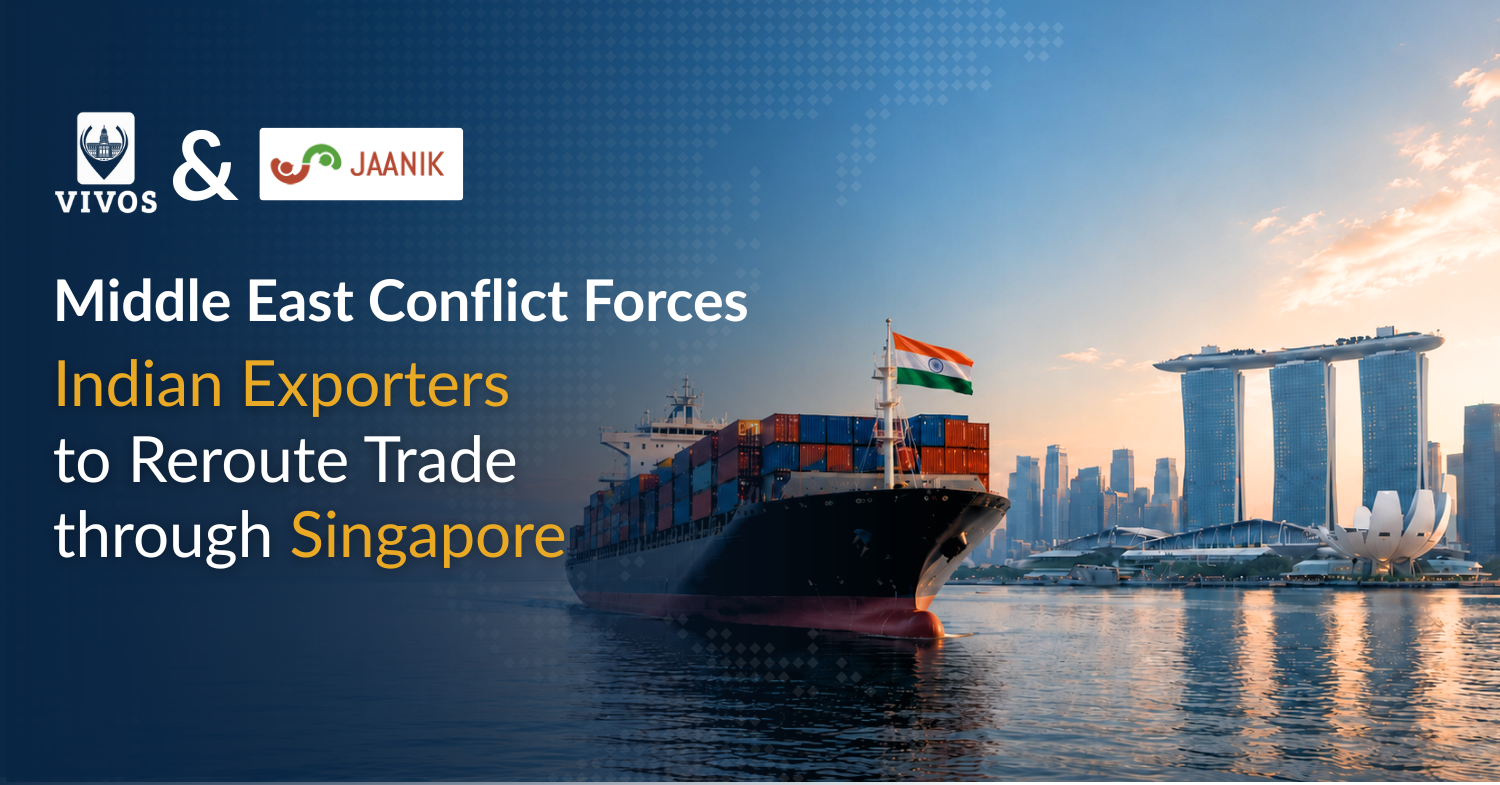
Middle East Conflict Forces Indian Exporters to Reroute Trade through Singapore
A Middle East disruption stalled an Indian manufacturer's Dubai setup. Jaanik rebuilt it in Singapore and restored trade continuity
Many businesses expand faster than their structures evolve. We step in to realign them so they can operate smoothly across markets.”
— Anne Kinnera, Managing Director, Jaanik Business Solutions (VIVOS Group)
SINGAPORE, SINGAPORE, SINGAPORE, May 7, 2026 /EINPresswire.com/ -- 7 may 2026, for an Indian manufacturer of industrial components, an export sale is never really complete until the money moves, and money moves, in this trade, through Letters of Credit.
A Letter of Credit is a bank’s written guarantee to a seller that payment will be made upon shipment of the goods and presentation of the documents. It is the backbone of cross-border trade in physical goods. Without a functioning LC, a shipment does not leave the factory. Without a functioning bank to process it, an LC is a piece of paper.
In early 2026, for a Pune-based manufacturer of precision-engineered auto components and industrial parts, that piece of paper became exactly the problem.
The Case Study: Built for Dubai, Broken by It.
The founder established a Dubai free zone trading entity in 2022. It was the rational choice. Jebel Ali connected his Pune-manufactured components to buyers across the GCC, East Africa, and Southeast Asia. UAE banks issued the LC in a jurisdiction that global buyers trusted. The factory manufactured. Dubai invoiced, shipped, and collected.
For three years, it worked. Then the Middle East conflict escalated.
The breakdown was cumulative. Dubai International Airport suspended operations. Marine war-risk insurance premiums spiked. Jebel Ali slowed as shipping lines rerouted. UAE banks, tightening compliance under regional uncertainty, stretched trade finance timelines by 15 days or more.
For procurement managers in Indonesia, Malaysia, and Thailand running live production schedules, a 15-day LC delay wasn't an inconvenience. It was a production risk. Penalty clauses were invoked. Years of built relationships began to strain.
By Q1 2026, the founder had already lost two repeat orders to competitors in Singapore and Taiwan. A third buyer in Vietnam made its position clear: future business would require a Singapore entity on the invoice.
“Most founders don’t realise this early enough, the structure you choose shapes how the world sees your business. A UAE entity made sense in 2022. What we kept seeing in early 2026 was founders discovering, mid-shipment, that the world had moved on.”
— Ray Tay, Co-Founder, VIVOS
What did Jaanik find?
The founder approached Jaanik Business Solutions, now part of the VIVOS Group, with an immediate operational problem: he needed to establish a Singapore entity capable of issuing trade finance instruments within weeks, because a buyer was waiting.
The Dubai free-zone entity lacked economic substance, transfer pricing between the Pune factory and the Dubai entity was undocumented, and the financial reporting did not meet the IFRS-aligned standards global banks expect for trade finance.
None of it mattered when Dubai’s role was simply to invoice and collect in a stable market. It mattered the moment the structure needed to adapt.
Jaanik's advisory covered four interlocking steps.
1. Incorporate a Singapore Pte Ltd. company for trading operations.
2. Establish the inter-company framework
3. Aligning reporting with IFRS/SFRS standards
4. Facilitating banking and trade finance relationships
From initial advisory to a fully operational Singapore entity with banking and trade finance pre-approval, the entire transition took just 11 weeks.
What Opened Up?
The Vietnamese buyer renewed. The founder re-engaged the Indonesian and Malaysian accounts he had lost, now with a Singapore entity on the invoice and DBS trade finance lines behind it. Within two quarters of completing the restructuring, he had added three new buyers across Southeast Asia.
Singapore’s position as a neutral, trusted global trade hub, one that sits at the centre of the ASEAN manufacturing supply chain, did what Dubai had once done for the GCC corridor, but with a more stable foundation and deeper banking infrastructure.
The Dubai Model was never broken; it was fragile.
Dubai’s appeal to Indian manufacturers was both practical and strategic — zero personal tax, the Middle East’s largest port, a gateway time zone connecting India, Europe, and Africa, and a banking system built for global trade. For over a decade, these advantages made Dubai a preferred choice.
What 2026 exposed was its dependence on regional stability. Once that broke, marine insurance costs rose, banking timelines became unpredictable, and Southeast Asian buyers shifted toward suppliers outside the conflict corridor.
For Indian manufacturers, the impact was structural. Engineering goods and auto components, India's third-largest export category to the UAE by value, depend on LC-based trade cycles. When banking slows, trade stalls. A 15-day delay may cost a components manufacturer, which means production-line penalties and damaged buyer relationships.
Singapore offered a stable alternative. Its trusted banking system, world-class port, familiar legal framework, and extensive trade agreements made it not just a holding structure, but a commercially credible operating base.
In 2025, Singapore recorded 77,579 new company registrations, up 8.5% year-on-year. Jaanik's inbound enquiries reflect a sharper shift: fewer founders are asking how to set up overseas, and more are asking how to move structures that have already stopped working.
The Advisory Difference: One Corridor. One Team.
International restructuring often fails due to fragmented advice across jurisdictions. Jaanik Business Solutions, now part of the VIVOS Group, simplifies the India–Singapore corridor through one integrated advisory team.
With 13 years in Singapore and 1,000+ businesses advised since 2011, the firm managed the manufacturer’s full 11-week transition from structuring and banking to compliance and reporting, allowing the founder to stay focused on business growth.
About Jaanik Business Solutions
Jaanik Business Solutions is a Singapore corporate services provider with over 13 years of experience advising more than 1,000 startups, entrepreneurs, and international companies since 2011. Now integrated into the VIVOS Group, Jaanik offers incorporation, accounting, taxation, payroll, and corporate secretarial services across three offices in Singapore.
About VIVOS Pte Ltd.
VIVOS is a Singapore-headquartered corporate advisory and professional services firm supporting entrepreneurs, investors, and international businesses across Singapore and the region. Services include company incorporation, corporate secretarial, accounting, tax advisory, banking support, immigration, and cross-border business advisory.
Ray Tay
VIVOS Pte. Ltd.
+65 9366 9399
contact@vivos.com.sg
Visit us on social media:
LinkedIn
Instagram
Facebook
YouTube
Legal Disclaimer:
EIN Presswire provides this news content "as is" without warranty of any kind. We do not accept any responsibility or liability for the accuracy, content, images, videos, licenses, completeness, legality, or reliability of the information contained in this article. If you have any complaints or copyright issues related to this article, kindly contact the author above.
